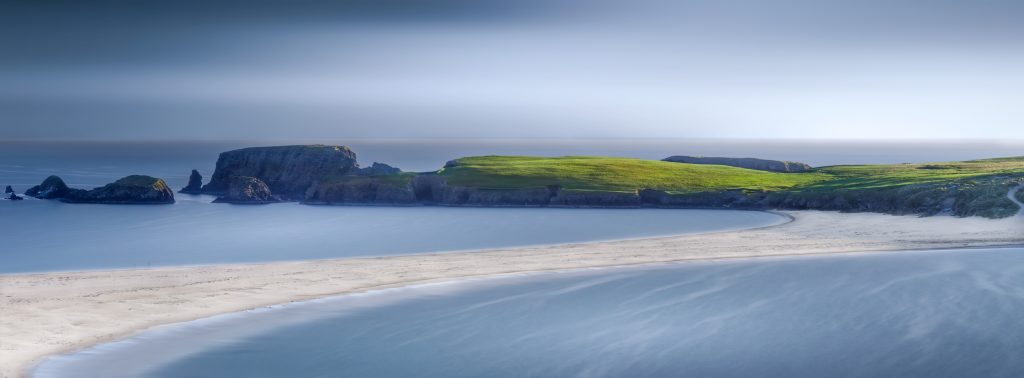
Exploring the light, locations, and compositions that make the Moray Coast a photographer’s dream.
There’s a certain hush to the Moray Coast — a softness that creeps in from the North Sea and settles over fishing villages, harbours, and sandy stretches. Unlike the west coast with its jagged mountains and dramatic light, this coastline whispers. And for a landscape photographer, those whispers are everything.
I’ve spent countless days wandering here, chasing light across dunes, cliffs, and cobbled streets. The Moray Coast may lack towering drama, but it offers something far rarer: authenticity, charm, and a pace that allows you to notice subtle shifts of light on water and stone.
Rattray Head Lighthouse – Solitude in the Surf
Few places embody the Moray Coast’s sense of isolation like Rattray Head Lighthouse. Standing sentinel off the Buchan coast, the elegant white tower seems to float above the waves at high tide. The walk through dunes and shifting sands feels almost pilgrim-like. For photography, timing is everything. Low tide allows access closer to the base, while high tide gives the illusion of the lighthouse adrift at sea.
At dawn, mist and first light paint the scene in silvers and blues. Long exposures transform the restless surf into a smooth, ethereal veil, and the solitude of the place becomes part of the story captured in every frame.

Bow Fiddle Rock – Sculpted by the Sea
Near Portknockie, Bow Fiddle Rock rises from the sea like the head of a colossal violin, its arch sculpted by centuries of waves and weather. The rock is both graceful and formidable — a natural monument that feels alive in the shifting light. I’ve stood here many mornings, tripod sunk into the shingle, waiting for that fleeting alignment of tide and sunrise when the first rays ignite the sea in molten tones of gold, copper, and rose. In late spring, the sun rises almost directly behind the arch, a moment that turns the water into liquid fire and the air into quiet awe.
The drama here isn’t only in the spectacle of dawn. On overcast days, when the sea turns slate-grey and the sky lowers like a curtain, the rock reveals its raw, sculptural beauty. The surfaces, etched with fissures and streaked with lichen, catch the faintest glimmers of light, making it an ideal subject for monochrome compositions. Long exposures smooth the restless sea into glass, allowing the solid form of the arch to stand out like a carved relic of another world.
Photographing Bow Fiddle Rock is as much about listening as it is about seeing. The echo of the waves through the hollow of the arch, the rhythmic hiss of pebbles tumbling in the tide, the gulls wheeling and calling overhead — all of it merges into a steady, meditative soundtrack. Each visit feels different: sometimes wild and roaring, other times still and contemplative. In those quiet moments between waves, when the sea holds its breath and the horizon softens, you sense the patience of time itself — a reminder that this rock, sculpted and scarred, has stood watch over the Moray Coast for millennia, waiting for light, tide, and the attentive eye of a photographer.

Bow Fiddle Rock
Findhorn Beach – Light, Space, and Silence To the west
To the west, Findhorn Beach opens out into a world of space and light. Vast dunes roll gently toward the horizon, their curves softened by wind and time, while the sea stretches endlessly under skies that seem too wide to belong to one place. Minimalist, open, and contemplative, this is a landscape that invites stillness — a place where the only sounds are the sigh of the wind through the marram grass and the slow pull of the tide retreating across the sand.
For a landscape photographer, Findhorn is a canvas of subtle moods. In winter, the light takes on a crystalline clarity, each grain of sand etched in sharp relief. The air feels cleaner, colder — perfect for long exposures that turn the waves into smooth ribbons of silver. At low tide, the beach transforms completely. Rippled sands catch the sky, mirroring the clouds in pools of shifting colour, creating endless opportunities for abstraction. Each passing moment changes the composition: a reflection here, a shadow there, the footprints of a bird gone with the next gust of wind.
The wooden groynes that stretch out to sea act as natural leading lines, drawing the eye toward the horizon where day fades into dusk. They stand like sentinels against the tide, weathered and stoic — reminders of the coast’s long conversation with the sea. Come evening, the light softens into hues of rose, amber, and violet. Sunsets here don’t blaze; they exhale. The colours melt together in slow gradients that seem to last forever, bathing the beach in a calm, unearthly glow.
There’s something meditative about photographing at Findhorn. You slow down, breathe with the tide, and let the rhythm of the waves dictate your timing. Every frame feels like a quiet dialogue between sea and sky, between motion and stillness. In a world that so often clamours for spectacle, Findhorn teaches you the beauty of simplicity — the art of noticing the spaces between things.

Findhorn Beach
Pennan – A Storybook Harbour
Small villages like Pennan feel frozen in time, as though the world has hurried on and left this tiny coastal gem to dream beside the sea. Famous for its role in Local Hero, the village has become part of cinematic legend, yet it retains a humble authenticity that’s far from the tourist gloss. The iconic red telephone box still stands proudly on the seafront, a symbol of connection in a place where cliffs, clouds, and sea seem to hold their own quiet conversation. It’s an irresistible subject for the camera — vivid against the muted tones of the old cottages and the restless grey-blue of the North Sea.
But Pennan’s true magic lies beyond that single frame. The cottages, built shoulder-to-shoulder along the narrow street, huddle against the cliffs as if seeking shelter from the elements. Each door and window bears the mark of salt and time, and in certain light — especially just after rain — the textures come alive. I’ve often found myself here in the early morning, when the air still carries the scent of seaweed and woodsmoke, waiting for the first light to spill over the cliffs and touch the village with warmth. That’s when Pennan reveals its heart — quiet, unhurried, timeless.
For a photographer, there’s an endless rhythm to capture: reflections in puddles after a storm, the curve of the harbour wall leading the eye into the horizon, gulls suspended midair in the breeze. Even on days of mist and drizzle, when the sky and sea blur into a single tone of silver-grey, Pennan’s textures and mood create images full of story and atmosphere. It’s a place that teaches you to look slowly — to notice how light moves, how history lingers, and how a simple coastal village can hold the weight of both memory and magic.

Pennan Seafront
Crovie – A Village Clinging to the Edge of Time
Nestled between cliffs and the North Sea, Crovie is the Moray Coast’s most intimate and hauntingly beautiful village. Its single row of stone cottages stretches along the shoreline, built so tightly against the cliff that cars are almost entirely absent. Walking through it feels like stepping back in time — every weathered door, every cobbled path, every fishing boat tells a story.
For a landscape photographer, Crovie is a dream of lines, textures, and subtle light. Early morning is magical: soft sunlight spills across the cottages, and reflections ripple gently in the shallow pools left by the tide. Shadows stretch long across the narrow lane, adding depth and contrast to every frame. In the evening, golden light warms the stone and highlights the delicate pastel tones of the painted houses, giving the village a nostalgic glow that’s impossible to resist.
Crovie’s history adds another layer of resonance. The devastating storm of 1953 destroyed much of the original village, forcing many families to leave. What remains today is a testament to endurance, a place where each photograph feels like capturing a story etched in stone and sea. Here, the interplay of village, cliff, and ocean provides compositions that are both intimate and expansive, turning the ordinary into something quietly extraordinary.

Crovie Seafront
Portsoy – Stone, Sea, and Story
Not far from Cullen lies Portsoy, a harbour town that feels as though it has been shaped directly from the sea itself. Its 17th-century harbour, built from honey-coloured sandstone, is one of the oldest on the Moray Firth — a perfect study in line, texture, and tone. When the tide slips away, the patterns in the wet stone glisten with reflected sky, offering abstract compositions that change with every passing cloud.
Portsoy’s charm lies in its imperfections — the uneven harbour walls, the salt-streaked doors, the fishing ropes coiled like sculptures. In the early morning, gulls drift in silence above still waters, and by evening the low sun warms the village into gold. For photographers, it’s a place where heritage and atmosphere meet, and where every corner holds a trace of those who worked and lived by the tides for centuries.

Portsoy Harbour
The Light of the Moray Coast
Throughout the Moray Coast, the light has a clarity that feels almost foreign compared to the west. Summer evenings bring a honeyed glow that lingers long after sunset, while winter days offer crisp contrast perfect for black-and-white work. Because this region faces north and east, sunrise and sunset photography over the sea is possible from different points along the coast — a gift few other Scottish shores offer.
For landscape photographers, the Moray Coast teaches subtlety. It rewards those who slow down, observe closely, and listen. Its beauty doesn’t demand attention; it invites. Every fishing net, rusted cleat, and tidal ripple carries a story — and every photograph becomes part of that ongoing conversation between land, sea, and time.

Reflections on the Moray Coast
The Moray Coast doesn’t compete for attention; it earns it slowly. There are no towering peaks or thunderous skies demanding to be photographed — only the gentle persistence of light, weather, and time shaping the land and sea. What it offers is something more enduring: a sense of belonging, of quiet connection.
Each time I return, I find new details hidden in familiar places — a change in the tide, a pattern in the sand, the way sunlight brushes the walls of Crovie or glints on the stones of Portsoy’s harbour. These moments are fleeting, but they carry the weight of centuries. For a photographer, that’s the gift of the Moray Coast: it teaches you to slow down, to see more deeply, and to find beauty in what others might overlook.
This coastline may whisper rather than roar, but its voice lingers long after you’ve gone — in the soft rhythm of the tide, in the memory of silver light, and in the quiet conviction that true beauty is often found not in spectacle, but in stillness.