The words photography workshop and photography tour are used so interchangeably these days that you can be forgiven for thinking they mean exactly the same thing.
I don’t think they do.
Both can take you to wonderful places. Both can put you alongside other photographers. Both can provide opportunities to make photographs that perhaps you wouldn’t otherwise have had.
But there is, for me, an important difference between the two.
And that difference isn’t necessarily about where you go.
It’s about why you are there.
The Destination or the Photographer
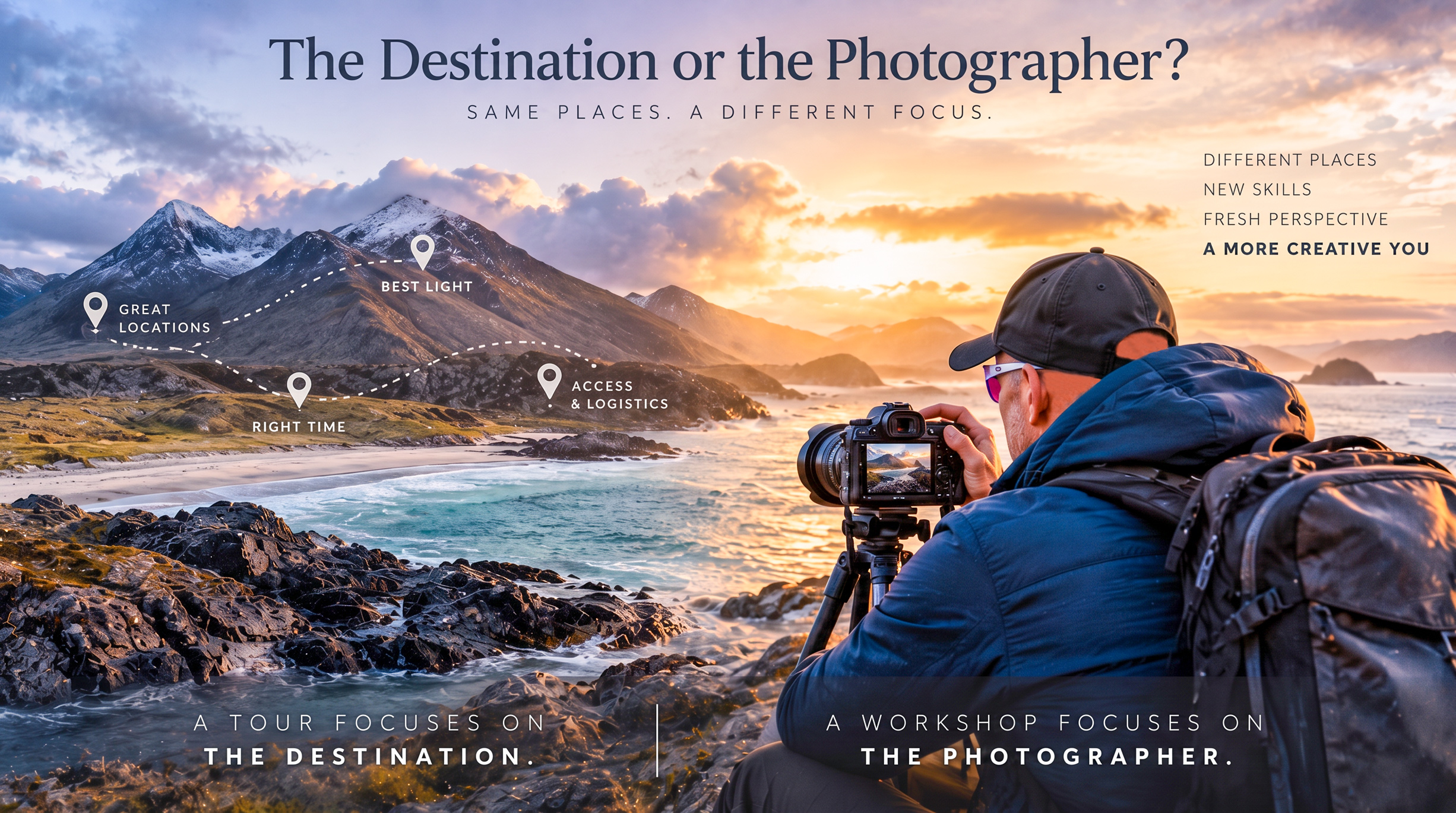
A photography tour is, generally speaking, built around the destination.
The emphasis is often on getting photographers to a selection of great locations at appropriate times of day and giving them the opportunity to photograph those places.
There is absolutely nothing wrong with that. I have done it many times.
For an experienced photographer who is confident with their camera, comfortable making their own creative decisions and primarily wants access to locations without worrying about research, transport or logistics, a photography tour can be exactly what they need.
Somebody else has done the homework.
They know where to park, where to walk, when the tides work, where the sun rises and perhaps where to go when the weather inevitably decides not to follow the forecast.
You arrive and photograph.
A workshop, however, should offer something more.
The destination is still important – of course it is – but the real subject of the workshop isn’t the landscape.
It’s the photographer.
A Workshop Should Involve Teaching
This sounds incredibly obvious, but I think it’s worth saying.
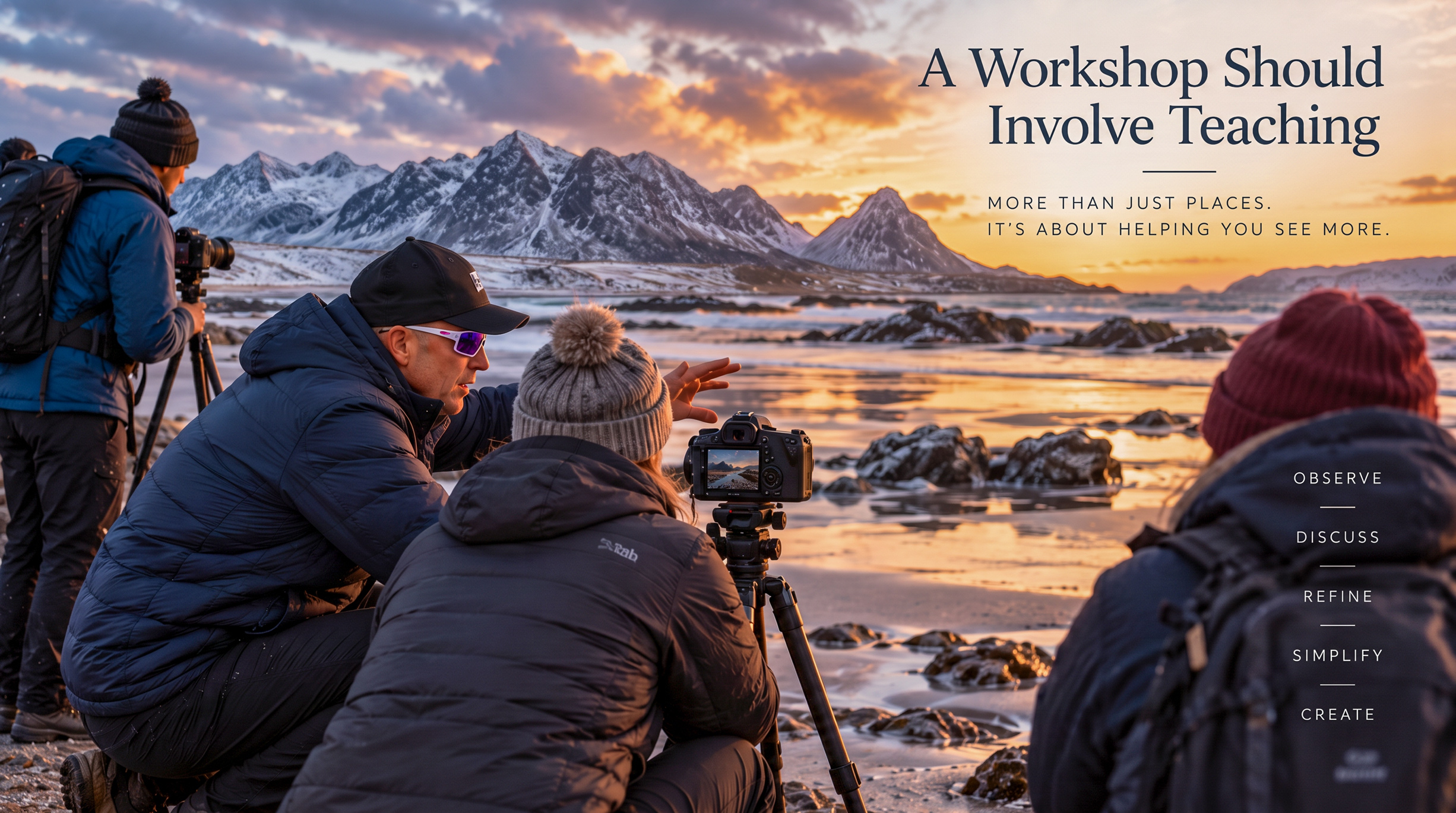
If I describe something as a photography workshop, then I believe there should be an element of teaching involved.
That doesn’t mean standing in front of a group of photographers delivering a lecture on aperture and shutter speed while everybody takes notes.
In landscape photography, some of the most useful teaching happens quietly.
It might be standing beside somebody and asking why they have chosen a particular composition.
It might be suggesting they move three metres to the left.
It might be suggesting they turn the camera just a fraction to the left to bring balance to the composition.
It might be asking them what attracted them to the scene in the first place.
Perhaps they are trying to include too much. Perhaps the photograph would be stronger with a different focal length. Maybe a square crop would simplify the composition. Or perhaps the best advice I can give them is put down the camera for ten minutes and simply look.
That’s teaching too.
Teaching doesn’t always mean providing an answer. Sometimes it means asking the right questions and allowing the photographer to find the answer for themselves.
And quite often, those conversations are more valuable than explaining which button to press.
You Don't Necessarily Need More Locations
One of the easiest ways to make a photography trip feel productive is to fill the itinerary.
Sunrise here.
Beach there.
Lighthouse next.
Quick stop at another viewpoint.
Then somewhere else for sunset.
You can certainly return home with lots of photographs.
But have you actually learned anything?
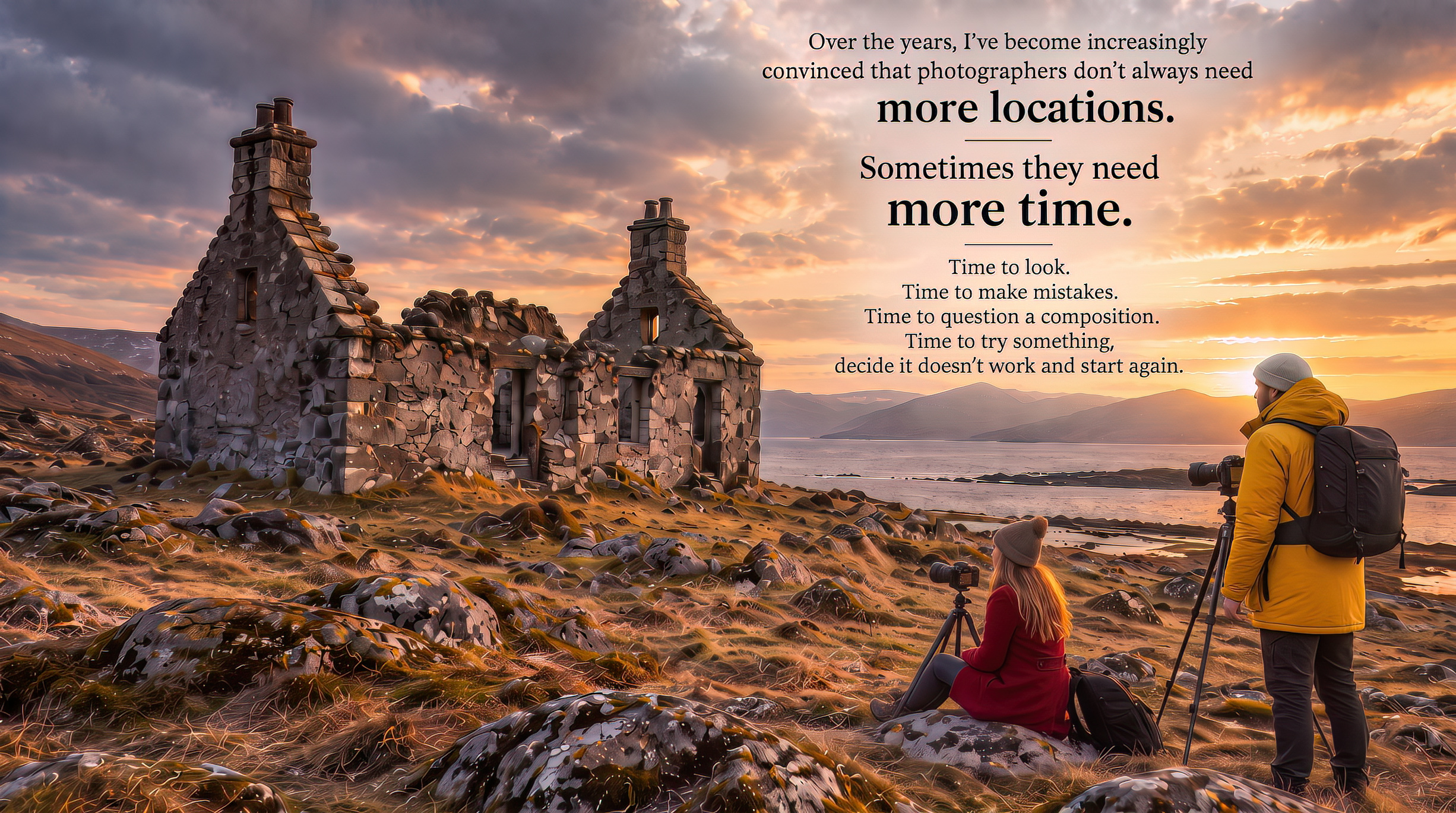
Over the years, I’ve become increasingly convinced that photographers don’t always need more locations.
Sometimes they need more time.
Time to look.
Time to make mistakes.
Time to question a composition.
Time to try something, decide it doesn’t work and start again.
On my own workshops, I’m quite happy spending a considerable amount of time at one location if I think the group is getting something from it.
There might be another three locations on my mental list for that day. They don’t matter.
The purpose isn’t to tick off places on a map.
The purpose is photography.
The Difference Can Be One Question
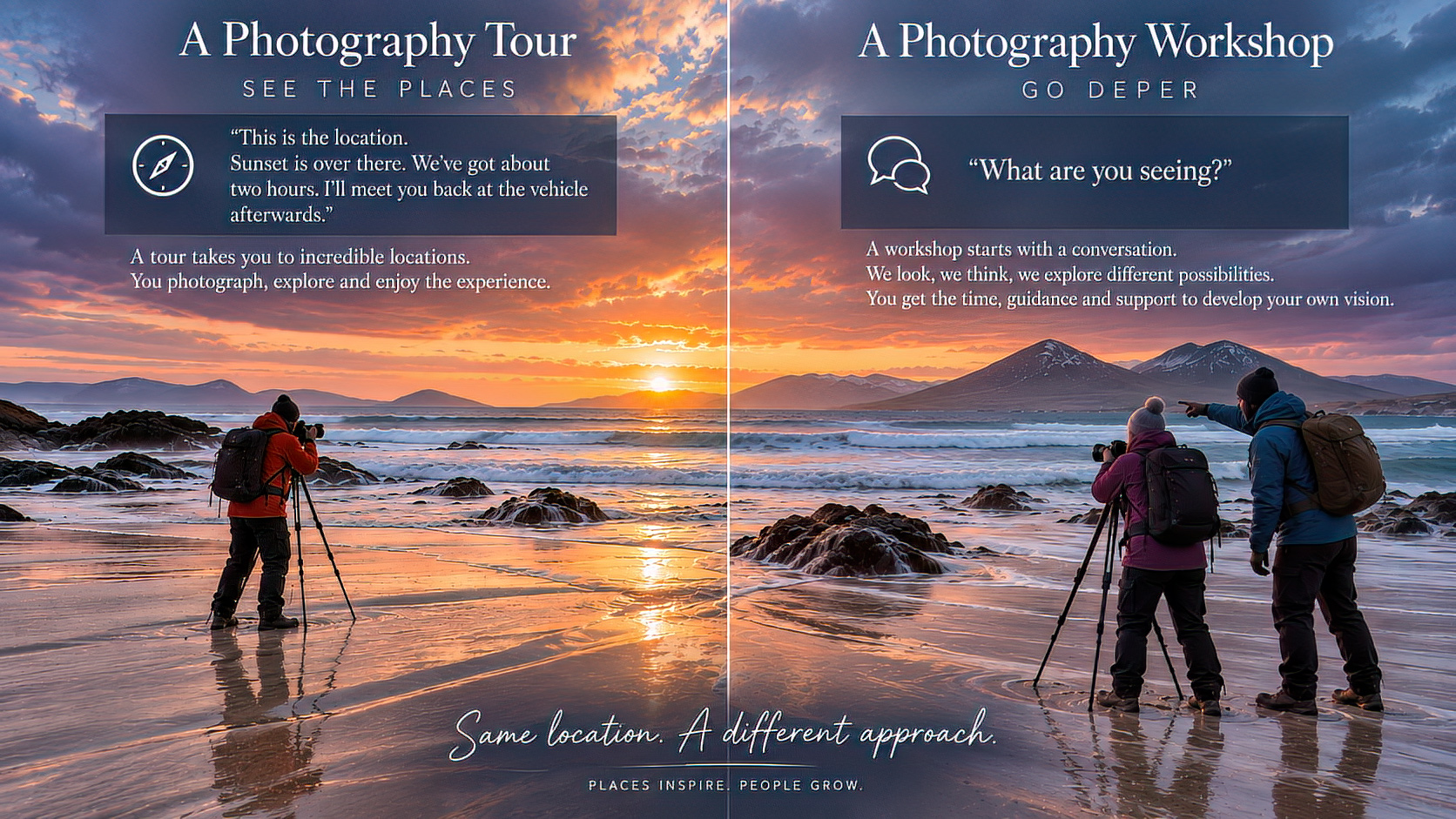
Imagine four photographers standing on a beach in the Outer Hebrides.
The light is changing. There are dunes behind us, patterns in the sand, turquoise water, distant mountains and an enormous Atlantic sky.
On a photography tour, the conversation might go something like:
“This is the location. Sunset is over there. We’ve got about two hours. I’ll meet you back at the vehicle afterwards”
Again, for some photographers, that might be exactly what they want.
But on a workshop, my first question might be:
“What are you seeing?”
That’s a very different starting point.
I’m not immediately telling somebody what photograph to take.
I want to understand what has caught their attention.
One photographer might be fascinated by the movement of the water. Another has noticed light catching the grasses. Somebody else is looking towards the mountains, while another photographer is completely overwhelmed by the sheer amount of information in front of them.
These four people are standing in exactly the same place.
But they don’t need the same help.
And that, for me, is where the workshop begins.
Teaching People, Not Groups
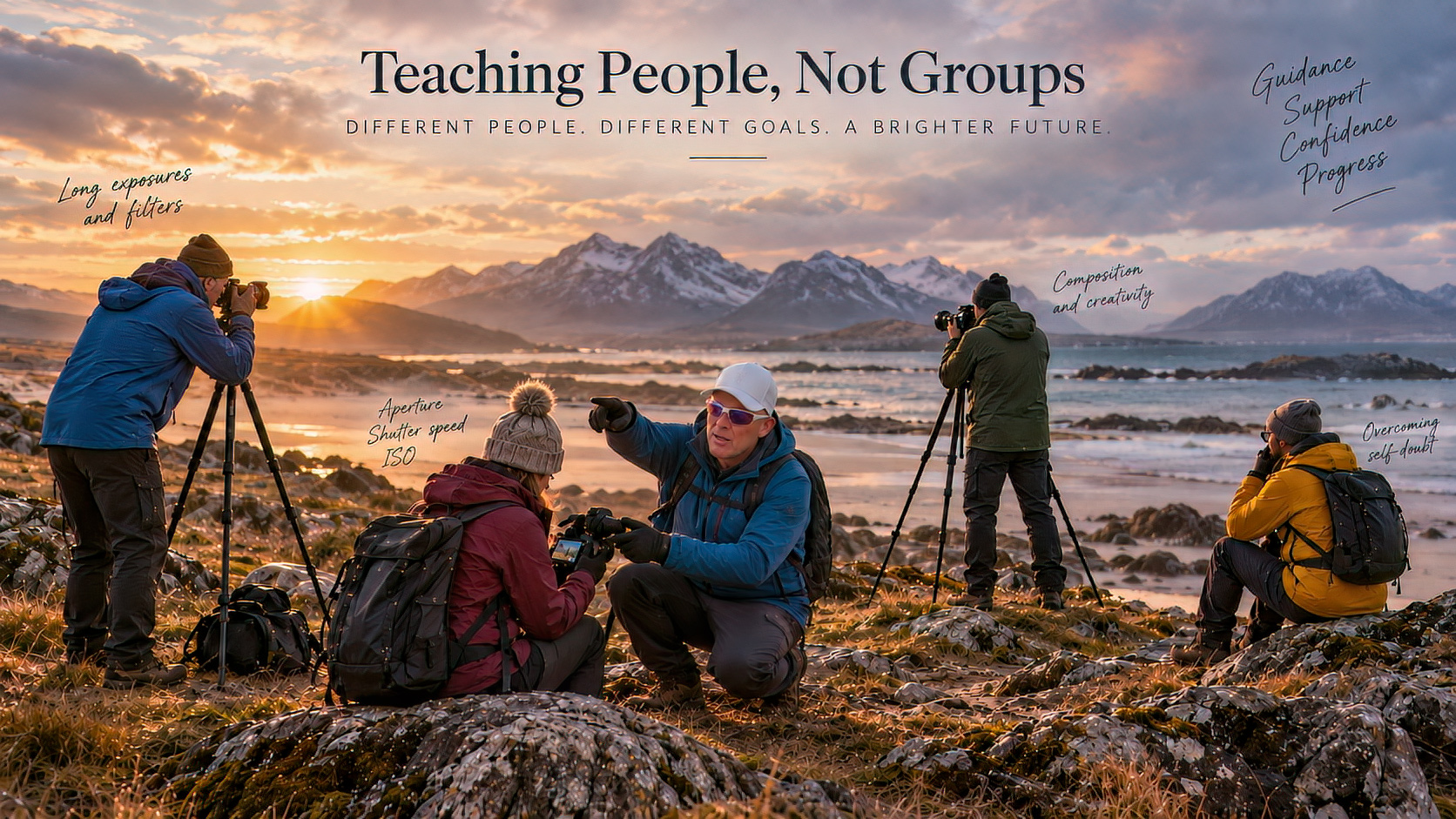
One of the challenges with photography workshops is that everybody arrives with a different level of experience.
Somebody might have been photographing landscapes for thirty years.
Somebody else may still be working out the relationship between aperture, shutter speeds and ISO.
One photographer might want help with filters and long exposures. Another wants absolutely nothing to do with technique and instead wants to improve their compositions.
Someone may be technically excellent but struggling creatively.
And sometimes the most experienced photographer in the group is the person suffering the greatest amount of self-doubt.
A workshop therefore shouldn’t feel like everybody is being pushed through exactly the same programme.
The teaching has to adapt.
My job isn’t to make four photographers photograph like me.
It’s to understand what each of them needs and help them to move their own photography forward.
That distinction matters enormously to me.
What About the Workshop Leader's Photography?
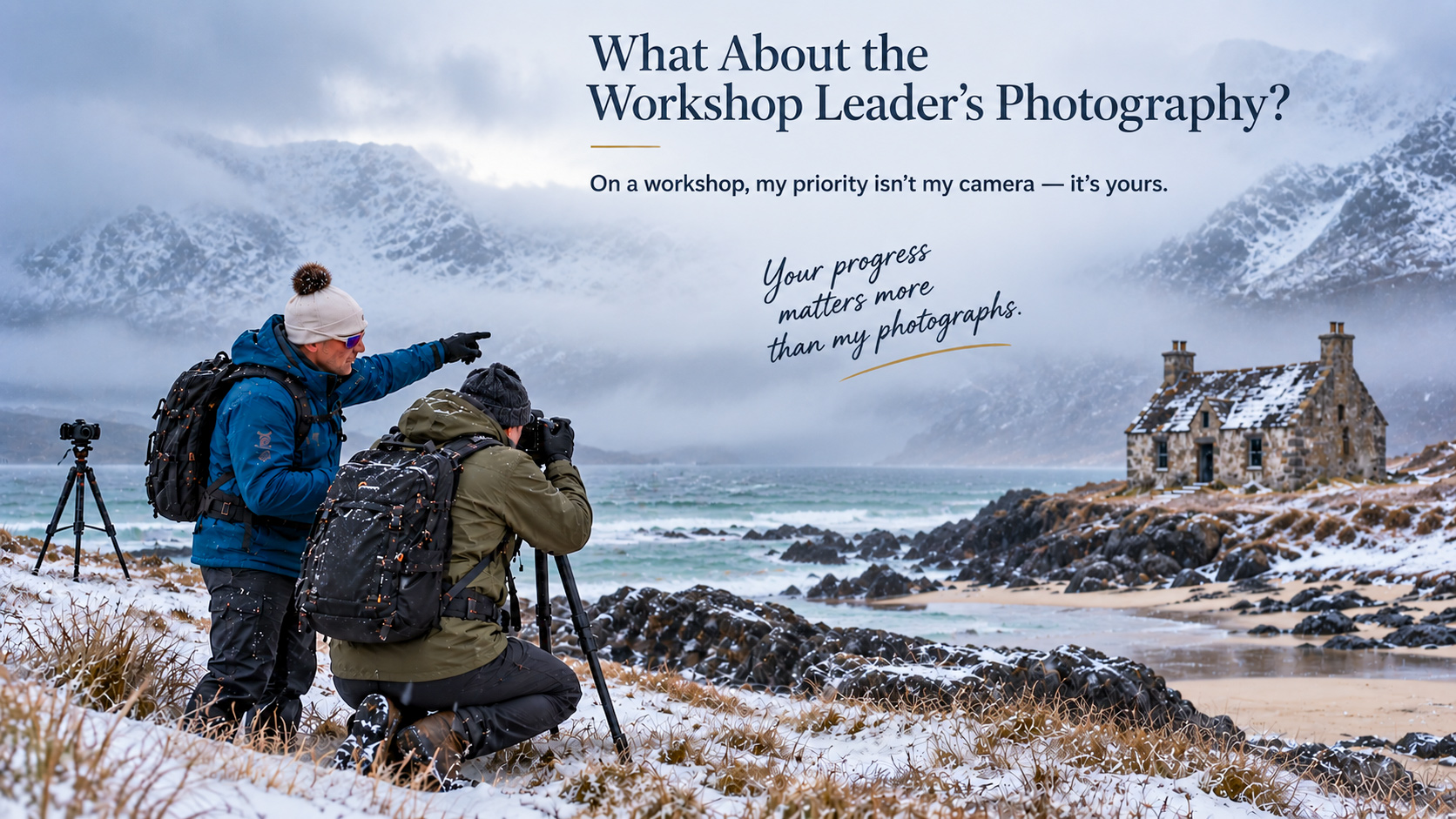
This is another area where I think workshops and tours can differ.
If somebody is leading a photography tour, they may reasonably expect to make their own photographs alongside the group.
On a workshop, I think the priorities are different.
If I’m working with somebody who is struggling with a composition and suddenly wonderful light appears, my priority isn’t my own camera.
It’s theirs.
That doesn’t mean I never photograph during workshops. Sometimes I’ll make an image to demonstrate an idea, show how I might simplify a scene or illustrate what a particular shutter speed does to moving water.
But I’m there primarily as a teacher.
The photograph I miss doesn’t matter.
The photograph or understanding — that somebody else gains does.
A Workshop Doesn't Have to Mean Constant Instruction
There is another side to this.
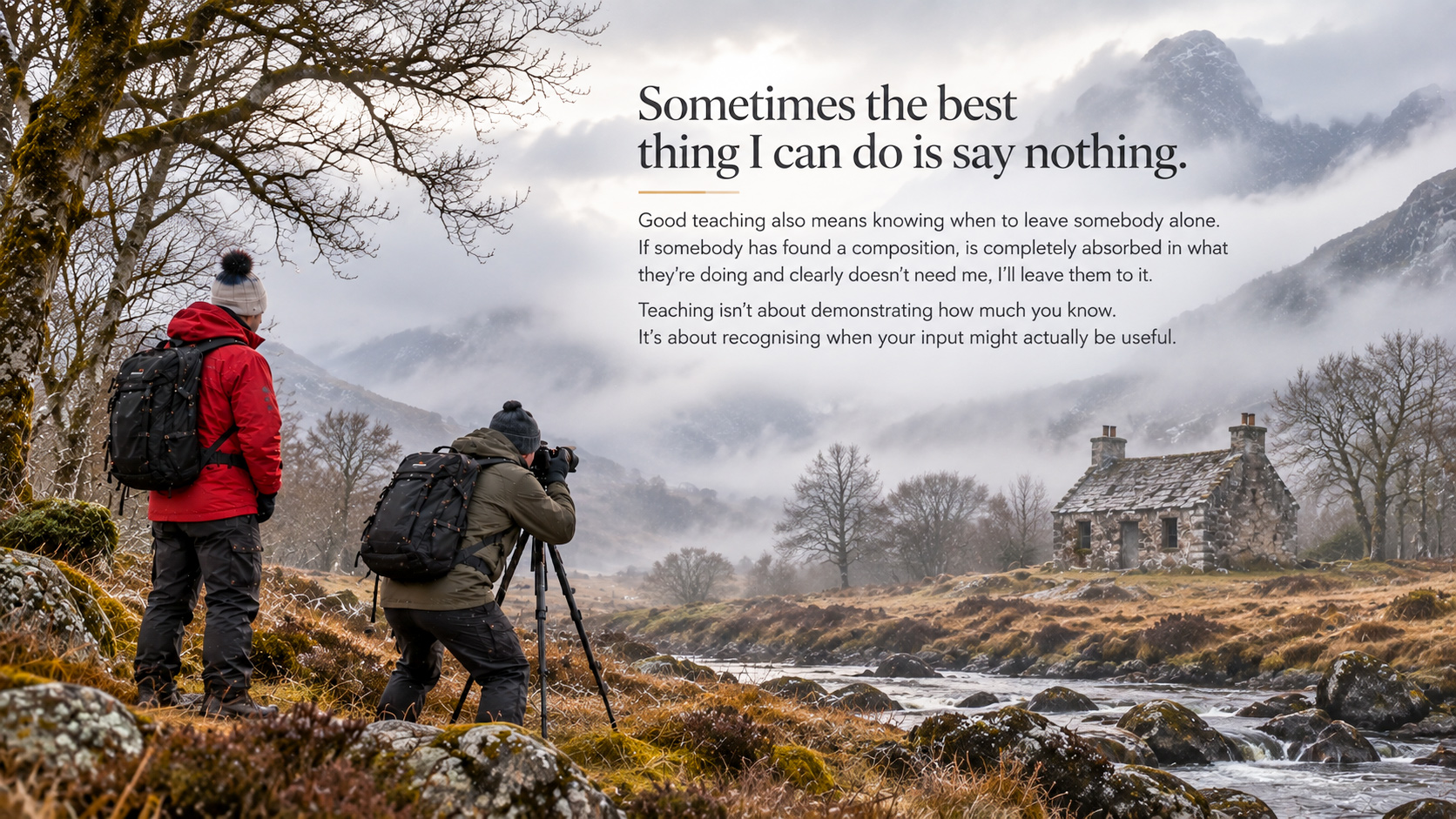
Good teaching also means knowing when to leave somebody alone.
Experienced photographers certainly don’t want somebody permanently standing behind them offering suggestions.
Sometimes the best thing to do is say nothing.
If somebody has found a composition, is completely absorbed in what they are doing and clearly doesn’t need me., I’ll leave them to it.
That’s part of understanding the individual.
Teaching isn’t about demonstrating how much you know.
It’s about recognising when your input might actually be useful.
So Which Should You Choose?
Before booking either, I think the most useful question you can ask yourself is:
What do I actually want from this trip?
If your priority is visiting great photographic locations, having the logistics organised and spending most of your time photographing independently, a photography tour may be ideal.
But if you want somebody to engage with your photography – to question you, encourage you, help with your technique, discuss composition and perhaps identify habits that you can’t quite see for yourself – then you are probably looking for a workshop.
But I also think there is a large area somewhere in between.
In my experience, quite a lot of photographers actually want a little bit of both.
They want to be taken to wonderful locations. They want somebody else to worry about the tides, weather, transport and where they might photograph tomorrow morning. But once they arrive, they don’t necessarily want to be taught every minute of the day.
They want the freedom to photograph independently when everything is going well, but they also want to know that help is there when they need it.
And perhaps that’s where the balance lies.
A good photography workshop doesn’t have to feel like a classroom in the landscape. There can be periods when everybody disappears into their own little world and simply photographs. At other times there might be a conversation about composition, technique or why something isn’t quite working.
The balance can change from photographer to photographer – and even from location to location.
It can change during the week too. Somebody might need quite a lot of help on the first morning and very little by the final day. In fact, that growing independence can be one of the signs that the workshop has done it’s job.
For me, thats probably where the best workshops sit: somewhere between guidance and independence.
Enough teaching to help somebody move forward, but enough freedom for them to discover things for themselves.
Neither a photography tour nor a workshop is inherently better.
They simply offer different experiences – and sometimes the best experiences borrows a little from both.
The important thing is knowing what you are booking and choosing something that gives you the balance you’re looking for.
Perhaps the Name Isn't the Most Important Thing
Of course, none of this is regulated.
There is no official definition of a photography workshop and no rule determining what somebody must provide before they can call their trip one.
A photography tour may contain excellent tuition.
A workshop may, in reality, operate much more like a guided tour.
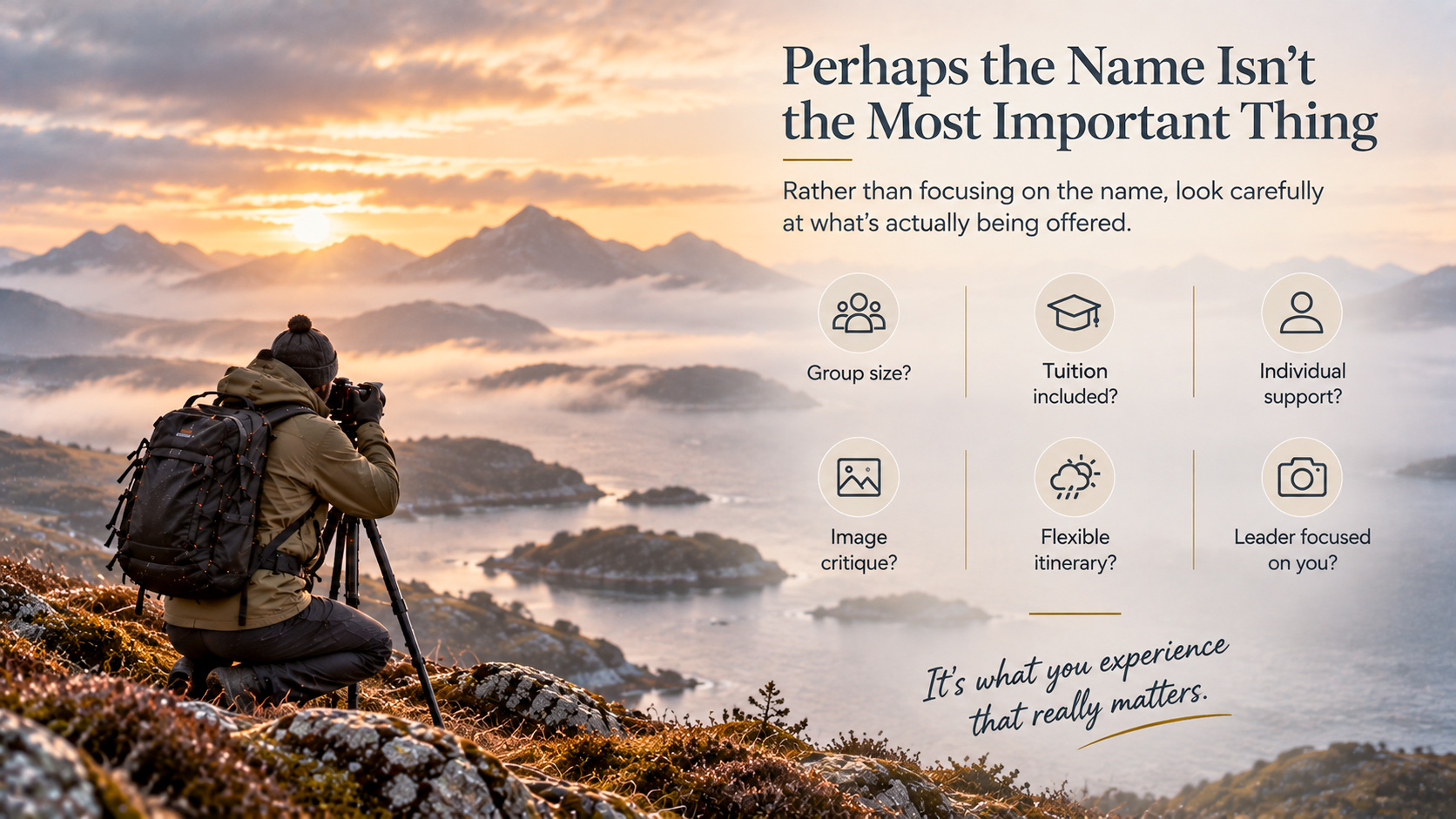
So perhaps rather than concentrating too much on the word being used, look carefully at what is actually being offered.
How large is the group?
Is tuition genuinely included?
Will the leader spend time with individuals?
Is there image critique?
How flexible is the itinerary?
What happens if the weather changes?
And perhaps most importantly, is the person leading it primarily there to make their own photographs or to help you make yours?
Those questions will probably tell you far more than the title of the trip ever will.
The Difference That Matters to Me
I run photography workshops in some extraordinary parts of Scotland and beyond, and naturally I want people who join me to experience those landscapes at their best.
But ultimately, I don’t measure a successful workshop by how many locations we visited.
Or how many photographs everybody took.
And certainly not by whether we witnessed an incredible sunset every evening.
I measure it by whether something has changed.
Perhaps somebody begins slowing down instead of rushing to make the obvious photograph.
Perhaps they finally understand long exposure.
Perhaps they start recognising distractions around the edges of the frame.
Perhaps they discover that they love photographing in a square format.
Or maybe they simply become a little more confident in trusting their own judgement.
Those can seem like very small things.
But take them home, apply them to the next landscape and the one after that, and they can influence somebody’s photography for years.
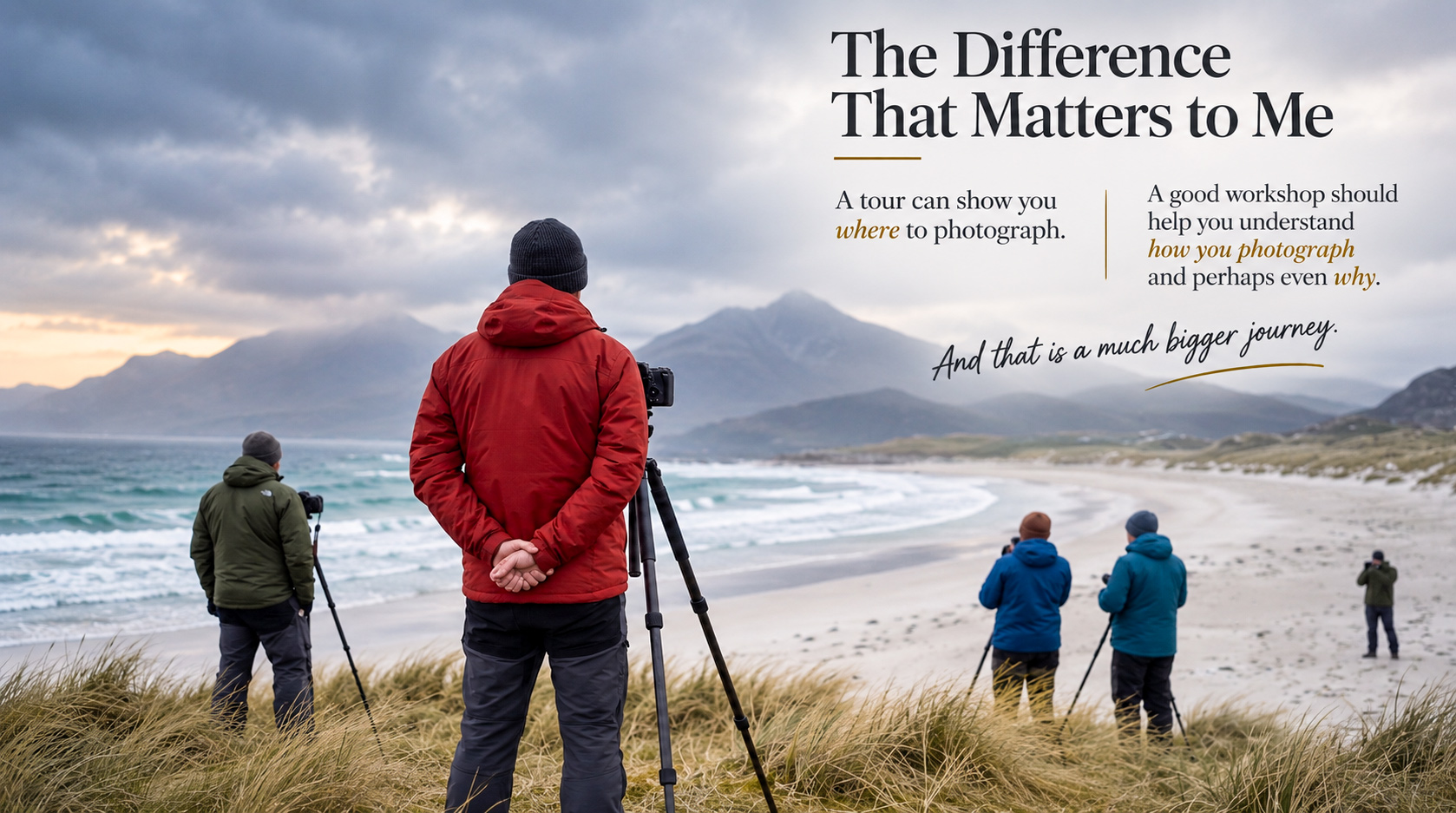
A tour can show you where to photograph.
For me, a good workshop should help you understand how you photograph – and perhaps even why.
And that is a much bigger journey.